A recruiter wants your ID before the interview. Verify the employer before the paperwork
Hiring eventually involves sensitive documents. The safety question is who is collecting them, why now, and through which verified process—not whether the form looks professional.
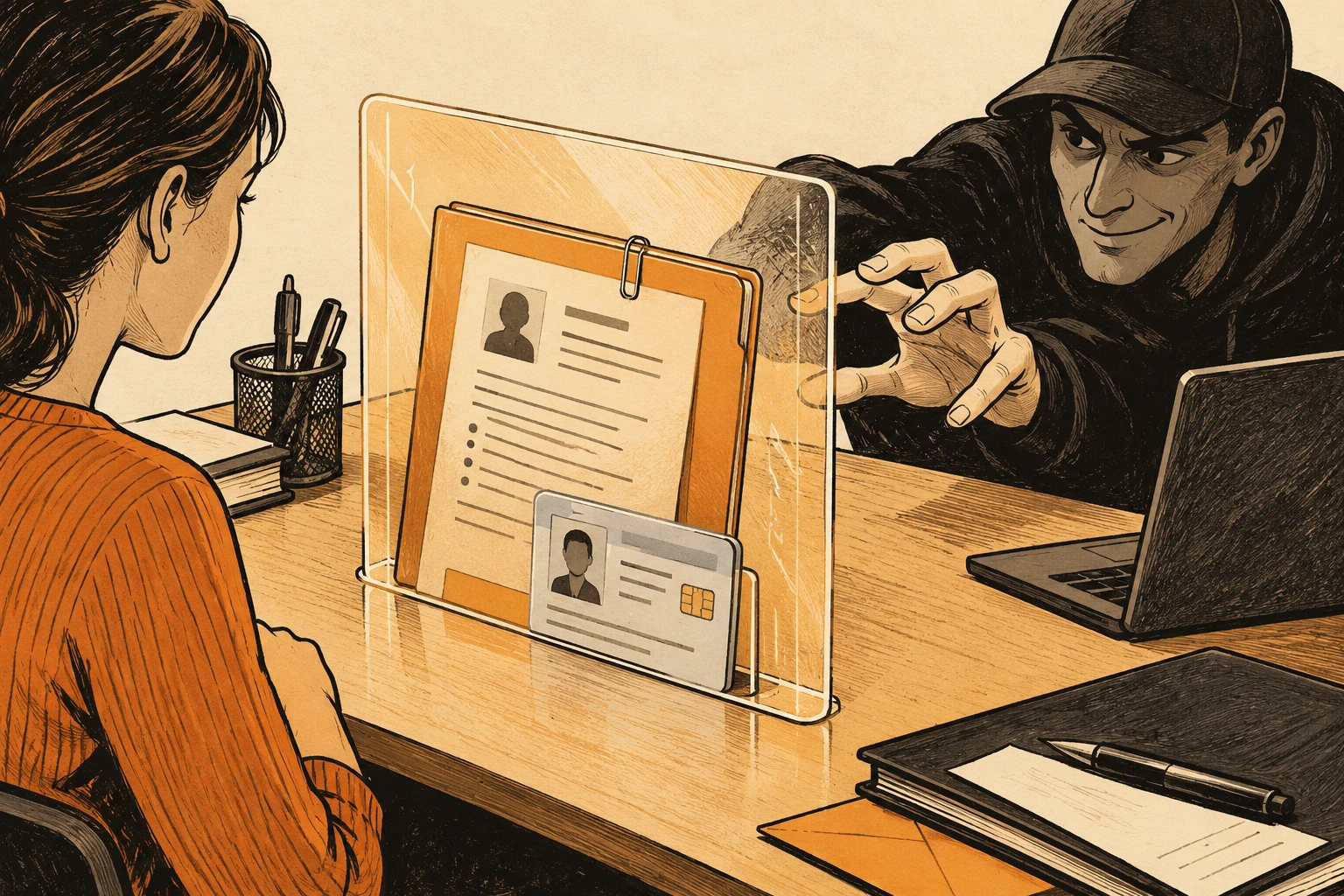
A recruiter says the role is a strong match. The salary is attractive, the interview can happen tomorrow, and there is just one administrative step: upload your driver’s license, national identification number, and banking details to complete the candidate file.
It is a difficult request to judge because real employment eventually involves sensitive information. The answer is not that employers never need identity documents. It is that a stranger’s claim to represent an employer is not enough to justify sending them.
Before sharing, establish the employer, the role, the person contacting you, the purpose of the request, and the collection route. The timing matters too. Information needed for payroll after a verified hiring process should not be treated as ordinary introductory conversation.
Three checks before the upload
Find the organization independently and confirm the opportunity.
Ask why the document is needed at this stage and who receives it.
Use a verified recruitment or onboarding system, not an unexplained personal inbox.
The FTC’s July 2025 job-scam warning describes purported recruiters seeking financial or identity information before a genuine hiring process. It highlights the importance of checking the recruiter rather than accepting an official-looking offer. A logo and a detailed job description are easy to reproduce.
Start with the employer’s own careers page and a contact obtained independently. If a staffing agency is involved, verify the agency too. Some legitimate vacancies are not publicly advertised, so absence from a job board is not a final verdict. It is a reason to obtain confirmation through a route the recruiter did not supply.
What an interview does not prove
A long interview can feel like evidence that someone invested real effort in evaluating you. Yet the FTC has warned about elaborate virtual interviews used in fraudulent hiring stories. Time spent talking does not authenticate the organization behind the call.
Ask questions about the actual work: the team, reporting line, location or remote arrangements, expected duties, and selection process. The answers should fit the employer’s real business. A person who repeatedly redirects practical questions toward document collection is not resolving the uncertainty.
Do not use accent, grammar, or nationality as the test. Legitimate employers recruit internationally, and fraudulent messages can be polished. The useful evidence is the verifiable relationship between the sender, the company, and the hiring process.
Match the information to the stage
| Request | Why it might arise legitimately | What to verify before sharing |
|---|---|---|
| CV and portfolio | Assessing suitability | Recipient identity and whether unnecessary personal data can be omitted |
| Right-to-work evidence | Employment eligibility requirements | Relevant local process, employer identity, and secure collection method |
| Background-check consent | Screening for some roles | Screening provider, scope, timing, and privacy information |
| Bank account details | Payroll after hiring | Confirmed employment and the genuine payroll process |
| Account password or login code | Not an ordinary hiring-document requirement | Do not disclose it to the recruiter |
| Payment for equipment or access | May be presented as onboarding | Stop and independently verify; do not fund a promised job |
Employment and screening rules vary by country and role. The table is a verification framework, not a statement that every document must be requested at one universal point. A legitimate organization should be able to explain its requirements without insisting that asking questions forfeits the offer.
A response that preserves the opportunity
You can say: “I am happy to complete the appropriate checks through your verified process. Please confirm the legal employer, the purpose of each document, the data recipient, and the secure submission route. I will confirm the request with the company before uploading.”
That is not an accusation. It gives a genuine recruiter a clear way to help. If the reply is a threat that the job will disappear in minutes, take the pressure seriously as a reason to pause, not as proof that you must comply.
For a document that is genuinely required, provide only the necessary information through the accepted process. Do not improvise redactions on a statutory form that must be complete; ask the verified recipient what is required. Equally, do not send a full identity bundle when a less sensitive confirmation would meet the stated purpose.
If the files have already been sent
Make an exposure list. Record which documents, numbers, images, signatures, account credentials, and financial details were shared. Keep the original messages, upload address, and job listing. Do not send more information because the recruiter now claims the first upload was unreadable.
Contact the real employer through an independent channel to check the opportunity and alert it to possible impersonation. Avoid publicly posting an unredacted identity document as evidence of the scam. The report should not create a second exposure.
If financial information was shared, speak to the relevant bank or provider. If an identity document was exposed, consult the issuing authority’s official guidance. A document number cannot always be made safe merely by deleting an account on the suspicious site, and replacement procedures differ by jurisdiction.
For US readers, the FTC’s credit-freeze and fraud-alert guidance explains tools that can reduce new-account identity misuse. A freeze must be placed with each of the three nationwide credit bureaus; it does not repair every kind of identity theft or stop misuse of existing accounts. Use official identity-theft recovery guidance for your particular exposure.
Watch the next request, not just the first one
Fraudulent recruitment can change direction. After collecting documents, the sender might introduce a check to buy equipment, a training fee, or a task platform that requires a deposit. Those are new financial decisions, not administrative consequences you must accept because you already completed an interview.
Our job-equipment check guide explains why money appearing in an account is not proof that a check has finally cleared. The task-job deposit guide covers the point where supposed earnings become a demand for your own funds.
If someone later offers paid removal of your identity data from “the scammer database,” verify that claim with the same caution. No stranger can guarantee that all copies of a document have been deleted.
Keep the search going without abandoning caution
A frightening experience can make every recruiter seem suspect. A more sustainable response is a repeatable boundary: ordinary application information first, sensitive documents only after the organization and process are established, and no passwords or payments to unlock an unverified job.
You are not being difficult by asking who will receive your information. You are assessing an employer at the same time it claims to be assessing you. A real opportunity should survive that basic level of professional care.
Found a factual error or a source that has changed?
Send a correction →