Your flight is cancelled. Do not let a fake support number make it worse
During a disruption, fast help can feel more important than verified help. Protect the reservation, the payment, and your next travel decision separately.
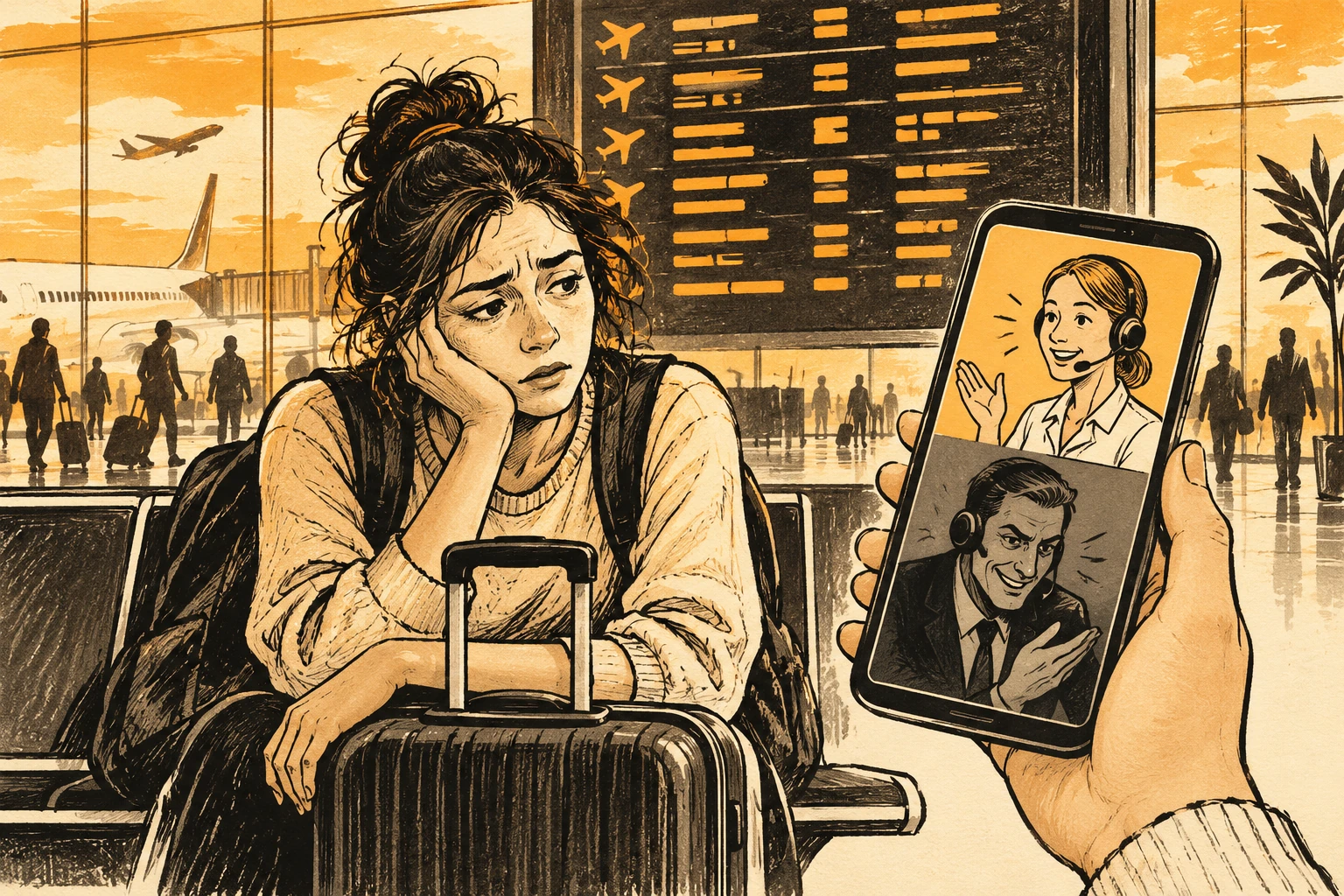
Your flight disappears from the departure board. The airline queue is long, the app is slow, and a search result offers an immediate human answer. Within minutes, someone who sounds helpful says your booking can be fixed for a fee.
Before discussing money, establish who answered. A person who knows your itinerary may know it because you just supplied the booking reference. Repeating those details back to you is not independent proof that the person works for the airline.
The priority is to regain a trusted route to the real reservation. You can sort out refund rights, alternative flights, and any suspicious payment once you know that the conversation is with the airline or the travel agent you actually booked through.
Use an airline desk or the contact route in its official app.
Do not post a booking code, boarding pass, or passport details.
Tell the real airline what was exposed and ask it to check the reservation.
The first five minutes
Open the airline app you already use or the website named in your original booking documents. Navigate to contact information from there. If you booked through an agent, use that agent’s independently established contact route, not a replacement number offered by someone replying to your complaint.
At an airport, a staffed airline desk gives you another way to confirm the situation. If there is a queue, you can keep your place while checking the official app. A stranger offering to move you to the front of a digital queue should not become your source of payment instructions.
The FTC’s airline-impersonation alert describes fake social accounts approaching distressed travelers. It recommends official airline channels and in-person staff. The alert is from 2024; the underlying contact-verification problem remains relevant without treating an old warning as a new incident.
Three things a fake agent may blur together
| Claim | Check through the real booking channel | Do not substitute |
|---|---|---|
| “Your seat was never confirmed” | The ticket and reservation status in the airline’s system | An email created after you gave someone the reference |
| “Pay this fee to receive your refund” | The actual refund process and reason for any charge | A transfer to an unrelated person or merchant |
| “We changed your flight” | The updated itinerary visible in the airline account | A screenshot of a supposed new ticket |
Travel agents can charge disclosed service fees, and airlines can charge for some voluntary changes. A fee is not automatically fraud. The problem is a party presenting itself as someone else or asking you to pay for a change that the actual carrier cannot confirm.
Ask who employs the person, what company will appear on the statement, and what service is being sold. If you intended to call the airline but reached a third-party agency, you can decline that service. You do not have to continue because you have already spent twenty minutes explaining your problem.
A cancellation is not every kind of travel change
For flights covered by US rules, the Department of Transportation’s refund guidance explains when airline cancellations or significant changes can trigger refund rights if the passenger does not accept alternatives. That is different from choosing to cancel an unchanged flight yourself. Your booking route and choices matter.
Consult the current official guidance and your real carrier before accepting a voucher, paying for a replacement, or abandoning the original reservation. Do not let an unverified caller interpret the rules for you. Other countries and itineraries have different protections, so a confident reference to “the law” is not enough without the relevant jurisdiction.
Make your decision explicit: do you want to continue traveling, or are you seeking a refund instead? Confusion about that choice can create a genuine service problem even after the scam risk has been removed.
If you have already given out the booking code
End the questionable call and contact the actual airline. Explain that an unverified party received the reference and passenger details. Ask staff to check for changes, cancellations, or altered contact information and to advise what protection is available. Do not assume every airline can replace a booking code or “lock” a reservation in the same way.
If you also disclosed account credentials, change the password through the official website and review account activity. If you gave card details or approved a payment, contact the card issuer separately. Protecting the booking and disputing a payment are two different jobs; completing one does not automatically complete the other.
Write down what was shared rather than guessing at the worst possible outcome. A name and itinerary, a passport image, a password, and a remote-access installation create different exposures. Give the airline and payment provider an accurate account so they can respond to the actual problem.
If you are helping a parent or another traveler
Avoid starting with “why did you call that number?” Ask which number they called, what the person requested, and whether anything changed in the real booking. Keep the traveler involved in decisions; taking over every screen can create more confusion during an already stressful journey.
A practical division is for one person to contact the airline while another preserves the payment receipt and messages. Do not have two people simultaneously cancel and rebook without coordinating. The goal is a single, confirmed travel plan, not several competing attempts to rescue the same ticket.
Our guide to hotel card-verification messages covers a similar problem after accommodation is booked. A message can contain true trip details while directing money to the wrong place. The fake purchase callback guide explains why the number supplied in an alarming message should not become the place you verify the alarm.
Keep a small travel contact kit
Before the next trip, save the airline and booking agent’s official contact routes, the reservation details, and any travel-insurance contact. Keep them in a place available if the airport connection is poor. Avoid sharing a full boarding-pass photograph publicly; celebration and complaint posts both reach people outside your travel party.
When a disruption happens, the safest help is not necessarily the first voice to answer. It is the voice whose relationship to your reservation you can establish without taking its word for it.
Found a factual error or a source that has changed?
Send a correction →