A “FBI” Call, a Real-Looking Number, and a Money Transfer: How the Impostor Scheme Works
A September 2026 FBI warning counted nearly 61,000 government-impersonation complaints. Learn why caller ID, case numbers, and video are not proof—and what to do before money moves.
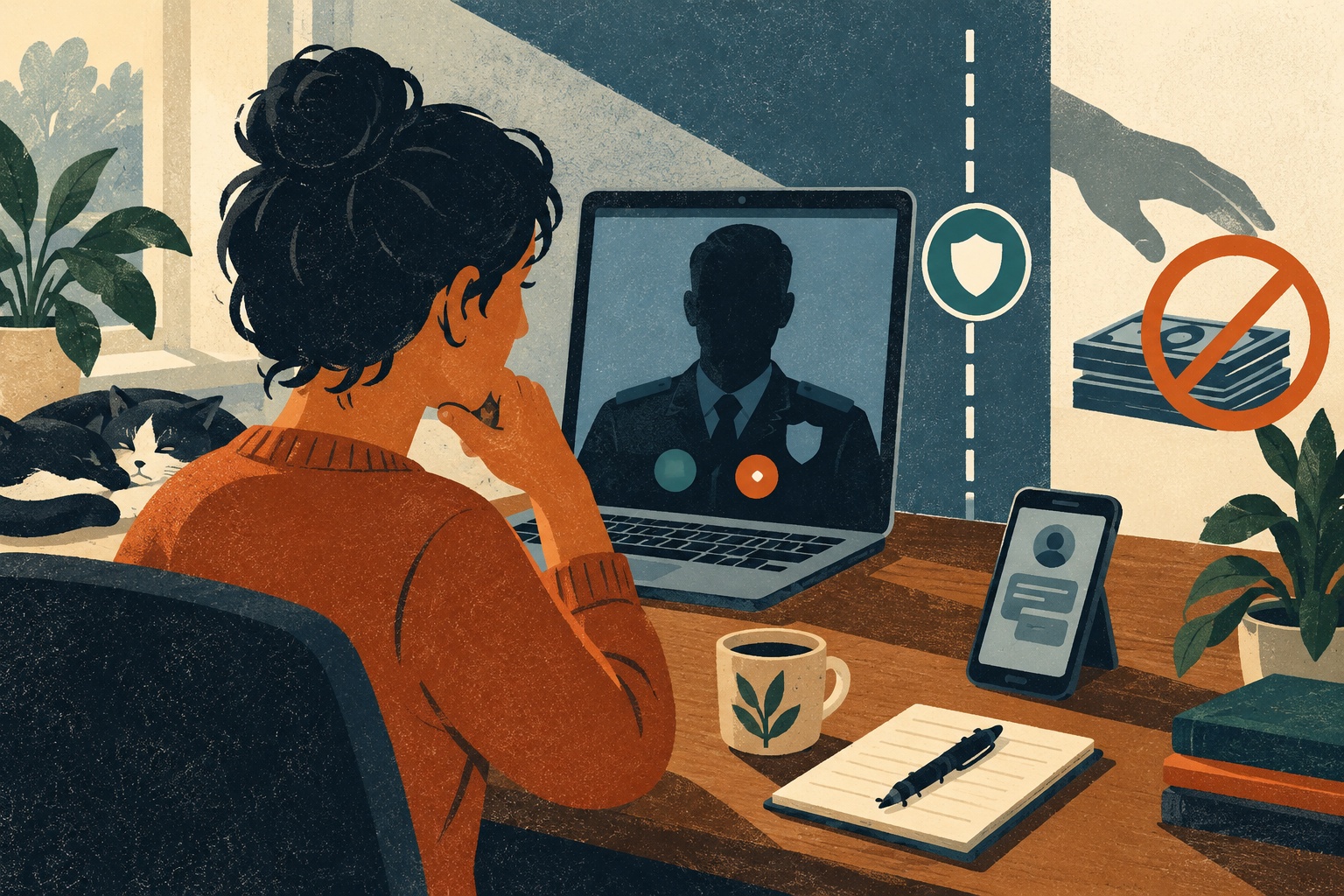
A September 2026 FBI warning counted nearly 61,000 reports of law-enforcement and government impersonation scams, with reported losses above $1.6 billion since January 2025. Recent Reddit accounts show why people hesitate: the caller may sound informed, display a familiar number, and hand the call to a second “agent.” Here is how to pause, verify independently, and protect money already at risk.
Quick answer: If someone who contacted you says you are under investigation and must move money, pay a fee, buy cryptocurrency, hand cash to a courier, or keep the conversation secret, stop. A displayed caller ID, case number, badge image, video call, or transfer from a supposed bank employee does not authenticate the person. End the contact and use a number or website you find independently. If money is about to leave your account, call your bank using the number on your card or statement immediately.
The pressure is not only “believe this story.” It is “stay with me while I control the next step.” The caller may say a card has been opened in your name, your identity was tied to a crime, a warrant is active, or a relative is in danger. They may tell you not to ask anyone else because the matter is confidential. The FBI’s September 17, 2026 public-service announcement describes those exact pressure patterns and warns that impersonators can use spoofed numbers, copied credentials, couriers, wire transfers, cryptocurrency, and AI-supported video.
What the September 2026 warning says—and what it does not
The FBI’s Internet Crime Complaint Center (IC3) reports nearly 61,000 complaints involving government or law-enforcement impersonation and more than $1.6 billion in reported losses from January 2025 through July 2026. Those are reported complaints, not a complete census of every incident. The advisory also identified 6,833 complaints about fake jury-duty or missed-court claims, with nearly $36 million in reported losses.
| Official figure or tactic | Careful reading | What it does not prove |
|---|---|---|
| Nearly 61,000 complaints; more than $1.6 billion reported lost | Government impersonation covers several schemes and is a large reported problem | That every incident uses the same script or all victims report it |
| 6,833 jury-duty or missed-court complaints; nearly $36 million | Fake legal deadlines and arrest threats are a documented variant | That a caller can authenticate a real case by reciting details |
| Spoofed numbers, names, emails, couriers, wires, crypto and AI video | Caller ID, appearance, and payment method do not establish legitimacy | That every official contact or video call is fraudulent |
Why a familiar phone number is not proof
A recent r/Scams post described an alleged American Express fraud call that was “transferred” to someone claiming to be an FBI agent. The poster said the displayed caller IDs matched the organizations and the callers supplied specific-sounding details. It is an individual account, not an official investigation, but it captures a common point of confusion: the familiar caller name feels like evidence.
The FBI’s own advisory warns that scammers spoof phone numbers, email addresses, employee names, and agency credentials. Caller ID shows what the call made the screen display—not who controls the line. A badge image, case number, official-looking video background, or correct personal detail can also be copied, staged, or invented. Do not reveal extra information to “confirm” that the caller has the right person.
If a caller says you can hang up and call back, use only a route you find independently. Go to the agency’s official website or use a contact on a document you already trust. Avoid numbers and links supplied by the caller, including sponsored search results. The FBI’s advisory specifically warns about look-alike domains.
The pressure sequence: from a frightening story to a payment
The story may begin with an alleged bank fraud alert: someone opened an account, bought something illegal, or used your identity. The caller offers to transfer you to law enforcement. A second voice appears to confirm the first story; a supervisor may then join. Multiple voices can feel like independent proof even when one group controls the whole call.
Next comes isolation. The caller insists you stay on the line, not tell family or the bank, or move somewhere private because the matter is “confidential.” That cuts off a neutral second opinion. Then comes a transaction: move savings to a “safe account,” withdraw cash for inspection, use a wire or crypto kiosk, buy prepaid cards, or hand money to a courier. The FBI lists these methods in its warning; payment is not made legitimate by a promise that it is temporary or traceable.
Some impostors use video to strengthen the performance. The FBI says AI tools have been used to make scammers appear as officials on video. A uniform, badge, familiar face, or official-looking background is still media supplied by the person who contacted you. Do not try to authenticate it while they are rushing you. Pause and verify outside the call.
What recent Reddit stories reveal about the pressure point
In a September 2026 r/Scams post, a user described a partner being told over several weeks that the FBI needed money to keep them out of jail. The partner initiated a wire transfer of the household’s savings; the bank’s verification call interrupted it before the money left. The writer described the fear of losing rent and food money. It is anecdotal, not a survey, but it shows how sincere a victim’s belief can be and how a neutral pause can help.
A second recent post described a caller claiming to be a bank representative who transferred the recipient to a supposed FBI agent. The poster said the caller ID looked familiar. The common pain point is not gullibility; it is being asked to decide under fear, while the caller supplies both the threat and the “proof.” If a bank asks why you are moving money, tell it the truth. A demand not to speak with your bank is a reason to contact the bank independently.
Embarrassment can delay action after a near miss. Report facts rather than trying to solve the case: who contacted you, what they requested, what information you shared, and whether a payment is pending. You do not need to identify the caller before asking for help.
A safe verification routine that does not dismiss real concerns
- End the interaction. Do not negotiate or wait for a supervisor. If there is an immediate physical emergency, contact local emergency services through a route you already know.
- Do not pay or move funds. No cash withdrawal, wire, crypto kiosk, prepaid card, courier pickup, or remote-access app because of an incoming call.
- Do not send secrets. Do not share passwords, one-time codes, recovery keys, Social Security numbers, bank details, or ID photos with the caller.
- Verify out of band. Find the agency’s official website or contact information independently. Do not use a number, email, link, or extension supplied in the message.
- Protect and report. If you disclosed anything, contact the affected bank or service through its real app/site or printed number. Save messages and receipts; report to IC3, local law enforcement, and the FTC as appropriate.
A real legal matter should be checked through a court or agency’s published process, not paid to an unsolicited caller. This is not legal advice and cannot determine whether a warrant or case exists. If you receive an actual legal document or are formally accused of a crime, verify it with the court or agency using independently located details and consider speaking with a qualified attorney. Do not ignore a genuine notice just because impersonation scams exist.
If money is pending, already sent, or collected
If a transfer is pending: Call your bank’s fraud department using the number on your card or statement. Say that someone claiming to be law enforcement instructed you to make the transfer and ask whether it can be stopped or recalled. Do not keep the caller on the line. If money was sent, contact the bank, wire service, or payment app immediately; recovery depends on the method and timing and is not guaranteed.
If you sent cryptocurrency: Contact the exchange or wallet provider you used, preserve transaction hashes and wallet addresses, and report the incident. Crypto transfers are often difficult to reverse; be wary of anyone promising guaranteed recovery for an upfront fee.
If you exposed identity or access: Change any disclosed password through the real service, secure the email account that can reset other accounts, and ask your bank what protections are appropriate. If your Social Security number was exposed, use IdentityTheft.gov. If you installed software or shared your screen, end the session and get help through the legitimate device or workplace support route. Do not chase a courier; contact local law enforcement and keep the messages and receipts. A “recovery agent” who contacts you privately may be another scammer.
Common questions
Can the FBI or a police department ever call someone?
Do not use “official agencies never call” as your only test. Agencies may contact people in legitimate matters. The FBI’s warning is narrower and more useful: officials will not demand payment by phone or text, and will not ask for payment through prepaid cards, cryptocurrency, or a courier. End an unexpected call and independently verify who contacted you and why.
What if the caller ID shows the real FBI office number?
That still does not prove who is speaking. The FBI warns that scammers spoof authentic phone numbers and credentials. Hang up and contact the office using information from the FBI’s official website, not a number sent by the caller.
What if the caller has my name or a case number?
Names and numbers can be copied or invented. Do not disclose more details to test the caller. Ask the official agency through an independently found contact route whether the matter exists.
Should I call the number back to prove it is real?
Not if the number or extension came from the unsolicited message. Find the agency’s official contact information yourself. Be careful with search advertisements and look-alike domains; the FBI cautions that fake pages can imitate official web addresses.
What if I already sent money?
Contact the bank or payment provider immediately through a trusted number or app, report exactly what happened, and follow its instructions. File an IC3 report and preserve the messages and payment details. Do not pay a stranger who says they can recover the funds.
The bottom line
Fear is the product being sold in a law-enforcement impersonation scam. The caller wants you to feel that a case is already moving, that other people are dangerous to involve, and that money must move now. Recent FBI data makes the scale clear, while ordinary people’s accounts show how a bank transfer, a believable voice, and a familiar caller ID can push a household close to a serious loss.
You do not need to decide in the moment whether the caller is real. You only need to refuse the transaction until you verify it independently. Hang up, contact the agency and the bank using details you found yourself, and bring in a trusted person. If the claim is genuine, it can be checked through official channels. If it is a scam, the pause breaks the caller’s control over the next step.
Related reading: how a government-benefit “boost” can turn into an impersonation pitch, our first steps after a scam, and the warning signs in fake remote-job offers.
Sources
- FBI / IC3, September 17, 2026: Scammers Impersonating Law Enforcement and Government Officials in Fraud Schemes — complaint and loss figures, tactics, and reporting guidance.
- Federal Trade Commission: How to Avoid a Government Impersonation Scam — consumer-focused guidance.
- FBI Internet Crime Complaint Center (IC3) — official reporting portal.
- FBI field offices — independently locate an office to verify a claimed contact.
- Reddit, r/Scams: September 2026 report about a spoofed AMEX/FBI call — individual account, not an official finding.
- Reddit, r/Scams: household nearly sent a wire after an FBI impersonation call — anecdotal account of a bank verification interrupting the transfer.
Found a factual error or a source that has changed?
Send a correction →