Paid through a parking QR sticker? Your parking fee may still be unpaid
A convincing sticker can create two separate problems: exposed payment details and a parking session the operator never received.
The most frustrating moment in a parking-payment scam is often not the payment itself. It is returning to the car and realizing that the receipt on your phone may have nothing to do with the parking operator. You followed instructions beside the space, entered the registration correctly and paid what looked like a small fee. Now you may have a card problem and an unpaid parking session at the same time.
Treat those as two separate jobs. Your bank can help with exposed card details or a suspicious transaction. The parking operator can check whether a legitimate session exists. Neither answer automatically resolves the other. A bank dispute is not a parking appeal, and a parking receipt does not establish that every website you visited was genuine.
Which website received the card?
Does the real operator show your session?
Keep the location, time and receipt privately.
At the meter: pause without becoming stranded
If you are still beside the vehicle, step out of traffic and stop interacting with the suspicious page. Do not spend ten minutes standing in an unsafe place trying to determine whether the square pattern looks authentic. A QR code is simply a way to carry information, often a web address. Its neat appearance says nothing about who placed it there.
Look for an independently verifiable payment route: the operator’s established app, a physical meter, or instructions confirmed on the operator’s official website. The available options depend on the location. A council car park, a private garage and street parking may use different systems, even in the same town.
If you cannot verify a lawful payment method within the applicable parking rules, consider moving to a location where you can. Do not assume that difficulty using a payment link automatically suspends time limits or enforcement. Equally, do not give an unfamiliar site more information simply because the clock is running. The goal is to leave the doubtful payment route, not to win an argument with its interface.
A real warning, with a local boundary
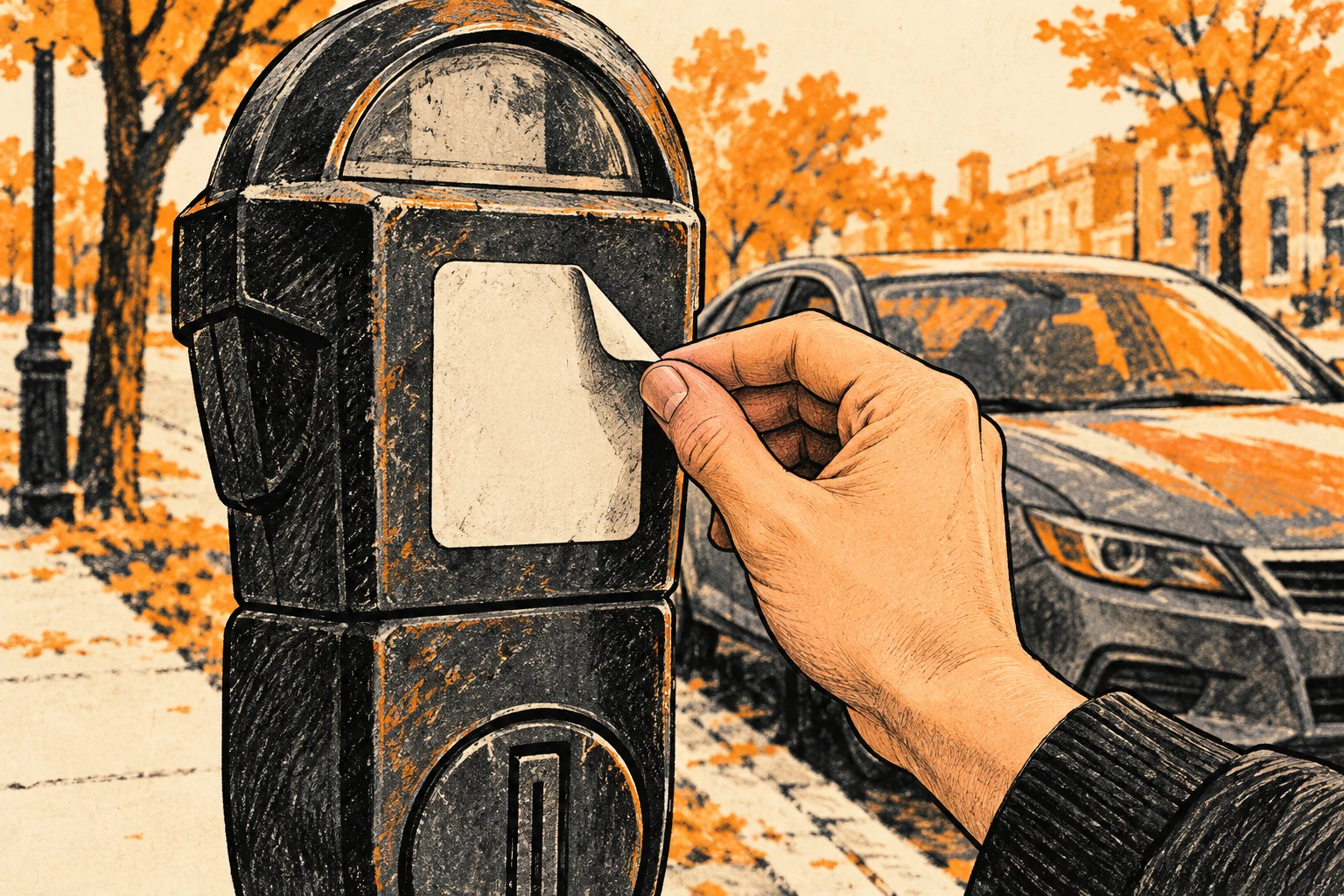
In its June 6, 2025 advisory, New York City DOT described a fraudulent QR sticker placed on a ParkNYC meter. The sticker directed people to a third-party page requesting card information. The agency identified the official app and physical meters as the legitimate payment routes for its system and told affected users to contact their bank or card company.
That is evidence about New York City’s system, not a rule that every parking QR code in the world is fraudulent. Dorset Council has also warned about scam stickers in its own parking environment. Different operators can legitimately use different technology. What remains constant is the need to establish the operator’s authorized payment route rather than trusting any sticker attached to its property.
The distinction matters because simplistic advice can create a second mistake. A visitor who hears “all QR parking is fake” may refuse a legitimate local method; another who sees one genuine QR system may trust every sticker elsewhere. Neither generalization is a substitute for checking the actual location.
What a receipt proves, and what it does not
A receipt proves that a page or service produced a record. It does not, by itself, prove that the parking operator received a payment, that the correct vehicle was covered, or that the time purchased matches your stay. Even a genuine payment can be attached to the wrong zone or registration.
Use the operator’s own app, machine record or support route to check the session. Compare the registration, location code, date, start time and duration. If the real system shows no session, explain what happened and ask what action is appropriate now. Record the answer rather than assuming that a sympathetic conversation guarantees cancellation of a later charge.
| Record you have | Useful for | Not enough to establish |
|---|---|---|
| Screenshot of the sticker | Showing the instruction at the location | Who installed it |
| Web payment confirmation | Reconstructing what the site claimed | A valid parking session |
| Card transaction entry | Identifying the merchant and amount for the issuer | Whether parking enforcement recognizes it |
| Official parking-session record | Confirming the operator’s recorded session | That a separate suspicious site did not capture data |
Keep these records together but label them accurately. Calling a fake confirmation “the parking receipt” in a dispute can obscure the very issue you need to explain. “Receipt from the site reached through the sticker” is more precise.
If you entered a card, work through the issuer
Contact the issuer using the established banking app or number on the card. Say that you entered the details on a suspected fake parking-payment page, and describe whether a transaction appeared. If the page requested multiple cards because the first supposedly failed, mention every card involved.
Ask the issuer what restrictions, replacement or monitoring are appropriate. Where a temporary lock is available, it can give you an immediate control while you make contact, but its coverage varies. Do not assume that locking a card retroactively cancels a transaction or resolves other information you entered.
If a banking code or approval followed, preserve the wording and time. Tell the issuer what you approved, not simply that you “verified parking.” The page’s label may not describe the bank-side action. This is also why a suspicious small charge should not be dismissed just because it is affordable.
If you only scanned the code and closed the page, say that. Scanning is not equivalent to entering payment data. Check for any downloaded file, installed app or unexpected permission, but avoid escalating every scan into a claim of complete device compromise. A factual account of your actions is more useful than the strongest possible description.
If a parking notice arrives later
Read the actual notice and its deadlines through a verified channel. Parking rules and appeal processes differ by jurisdiction and operator, so there is no universal promise that a fraudulent sticker will cancel a charge. Do not ignore a genuine notice on the assumption that your bank report has already dealt with it.
Prepare a simple chronology: arrival time, exact location, visible instructions, attempted payment, discovery of the problem, contact with the operator and any subsequent payment. Attach only relevant evidence and redact unrelated financial details. Explain the request you are making, such as asking the operator to review the circumstances and its payment record.
This publication cannot determine liability or appeal rights for an individual parking dispute. If the amount or consequences are significant, use the operator’s official process and appropriate local consumer or legal advice. The practical contribution you can make immediately is an organized record rather than a collection of disconnected screenshots.
A sticker inspection is only one layer
Lifted edges, mismatched material or a sticker covering printed instructions can be warning signs. Their absence does not prove authenticity. A well-made overlay may look ordinary; a legitimate weathered sign may look untidy. Visual inspection helps generate a question, not answer it definitively.
Similarly, a padlock or HTTPS connection tells you about the connection to the site, not whether the parking authority appointed that site to collect money. A convincing operator name in a long address is not enough. The payment route needs to match a source you reached independently.
Do not remove or alter equipment simply to investigate. Report the exact meter or zone to the operator, and follow any official local instruction about the sticker. Avoid confronting other people nearby or assuming you know who placed it. Your evidence concerns the object and the request, not an identified offender.
Make the next parking stop easier
Before a trip, identify the expected parking operator and install any genuine app through its official route if one is useful. Save a working payment method and check that the vehicle registration is current. This reduces the temptation to follow the first convenient link when you are late, carrying bags or trying to meet someone.
When traveling with another person, divide the tasks: one checks the location and permitted stay, the other verifies the payment route. Do not let a passenger’s confidence replace the check; have them show the operator’s actual record. For shared vehicles, confirm which registration is selected before paying.
The broader lesson also applies to unpaid toll texts: real infrastructure and a plausible fee do not authenticate an unrelated payment request. For an example where a tiny charge masks larger exposure, read the parcel redelivery guide.
Before you leave this page
If you are helping someone else with the incident, separate the tasks between you. One person can contact the card issuer while the other records the location and finds the real parking operator. Do not both repeatedly retry the questionable payment page. Agree where receipts and case references will be kept, without exchanging full card details through ordinary messages. A short shared timeline makes follow-up easier when the operator and bank ask different questions.
Ask three concrete questions: have I secured any exposed payment details, have I checked the real parking session, and have I saved the information needed for a later dispute? If one answer is no, work on that specific gap. You do not need to identify the scammer or become an expert on QR technology to take the next useful step.
Sources: NYC DOT’s parking-meter advisory and Dorset Council’s warning. The workflow above is an editorial framework; local payment and appeal rules remain controlling.
Found a factual error or a source that has changed?
Send a correction →